

When it comes to the standardisation of healthcare data, there are many challenges. The handling of demographic data has long been seen as one of those challenges – but did you know that the openEHR Specifications has its very own Demographic Information Model? We are keen to tell you more about it.
Why openEHR?
Those familiar with openEHR should already be aware of its benefits, but for those relatively new to the material, we’ll briefly list them:
- Using an openEHR data layer means a separation of data and application, which leads to more flexibility and a higher degree of data security;
- The very foundation of openEHR is based on the ongoing international collaboration of both healthcare professionals and developers;
- openEHR is patient centric, with a ‘data for life’ approach, which is crucial for continuity of care;
- openEHR aligns with legislation such as the European Health Data Space.
With openEHR implementations (ranging from individual software vendors to healthcare organisations, regional collectives and even entire national architectures) popping up all over Europe, openEHR is rapidly gaining ground.
So what is the deal with the demographic data?
One of the reasons why any kind of change in healthcare IT is often complex, is the fact that there are plenty of (legacy) systems in place, with enormous amounts of data that has been accumulated over the years. Those legacy systems likely already have a solution in place for storing demographic data, such as a patient’s identity, treatment relationships, cohort and any relevant grouping features. When organisations facilitate the exchange of this demographic data, they often used HL7 FHIR technology to make it happen.
However, now that the adoption of openEHR is on the rise, challenges also arise:
- What to include?
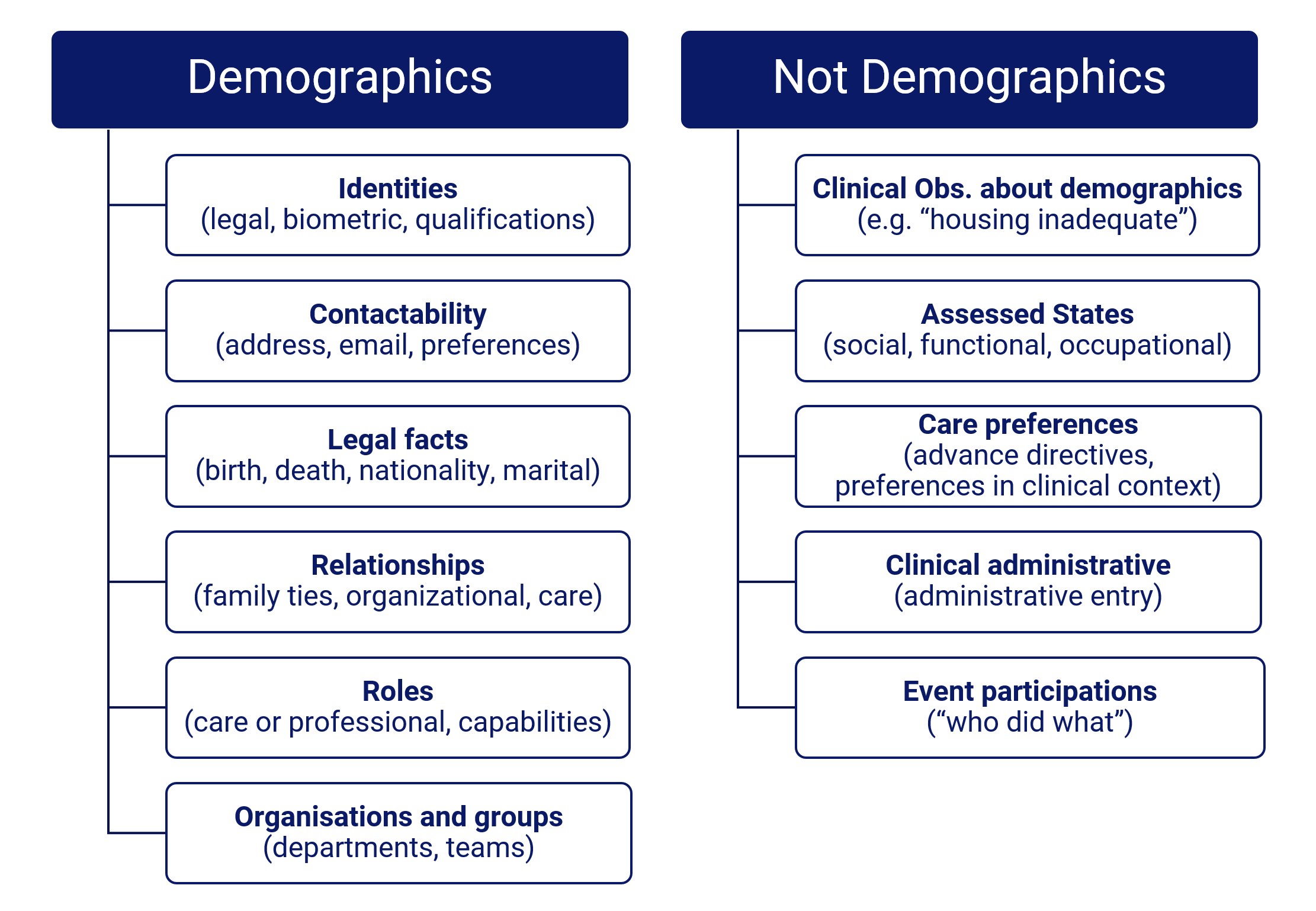
Even the very definition and limitations of demographic data is not as clearcut as one might think, and has led to many a lively discussion. What should be included and what does not? To what degree do the demographic data have clinical relevance, and if it does, why can’t it be modelled within openEHR’s clinical archetype domain?
From Cadasto’s point of view, we consider all data to be demographic data that consist of facts about people and organisations that are truly independent of any clinical event. This leads to the following categorisation:
- A unified view
You want a unified view of your demographic domain and your clinical data. When your EHR data storage is based on openEHR and your demographic data is based on a system that supports HL7 FHIR exchange or is not standardised at all, this is not an easy feat – additional software is required to map the data between these standards, or to create a unified view that encapsulates both kinds of data. - Querying
For a long time, there has been no AQL (Archetype Query Language) support for demographics in the openEHR standard. And if you store your demographic data separately from the EHR, you will not be able to query the demographic data using AQL anyway. This makes data analysis based on demographic characteristics unnecessarily difficult.For the Cadasto platform, we have extended the AQL to include the openEHR demographics storage, and with great results – after all they are both part of openEHR Reference Model, and demographic data can be modeled with archetypes. - Historical data
In current setups, historical demographic data (such as an old address or even former care relations) are often simply not available. Having such historical data available can prove valuable for both research and prevention purposes. The openEHR Specifications has a versioning mechanism available for all openEHR persisted data – including demographic data.
One standard, less complexity
At Cadasto, we believe that all ingredients are available to standardise demographic data without added layers of complexity – by fully embracing the openEHR standard and what it has to offer. Why would you reinvent the wheel, when the openEHR Demographic Model was made to go together with the full openEHR Specifications, Archetypes, Templates, APIs, AQL and all, and can benefit from all it has to offer?
When you use the Cadasto open platform, support for the openEHR Demographic Model is part of the deal. We’d love to discuss the challenges and needs of your organisation when it comes to storing demographic data – do get in touch.
Let's Unlock the Full Potential of Demographic Data
Curious how openEHR can strengthen the way you manage and use demographic data? Our experts are happy to explore what this could mean for your organisation and challenges.