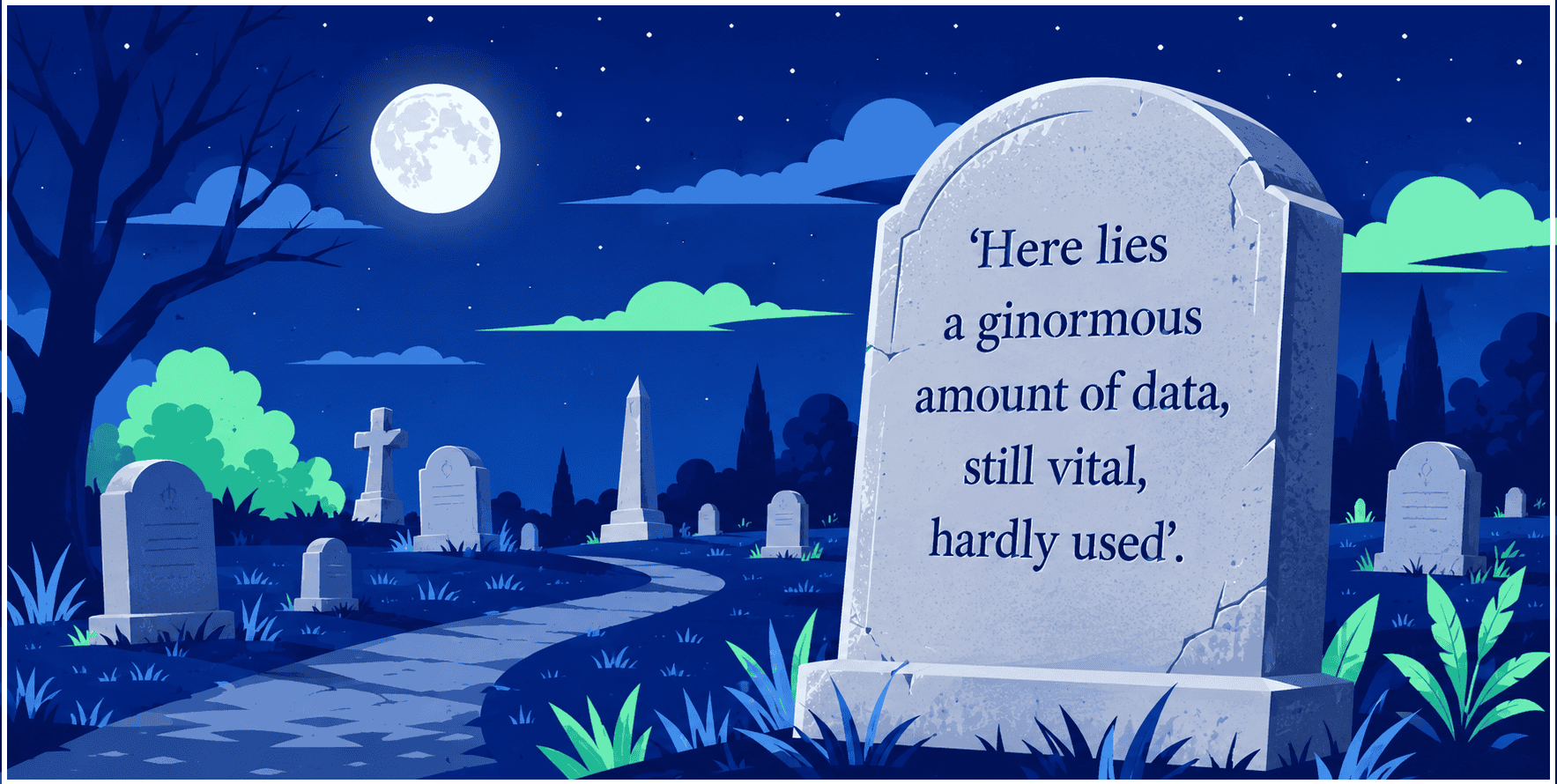

For many healthcare organisations, their EHR system is their ultimate ‘single source of truth’. Yet, without making intentional choices regarding infrastructure and data architecture, this amazing resource is at risk of becoming something of a data graveyard: a massive repository where data is stored, never to be read, analysed or utilised again.
Oof.
It goes without saying that a challenge this big is not solved in four simple steps (if only!). Even so, we believe that these four strategies are important to keep in mind to prevent your vital care data from being ‘buried alive’.
1. Commit to Data Standardisation and Interoperability
Most legacy EHR systems use a data structure specific to its vendor. This in and of itself leads to a huge amount of siloed data. To further complicate matters, within most (larger) healthcare organisations, different departments use different subsystems using their very own terminologies and data structures. This makes interoperability, reusability of data across systems and cross-departmental research complex and costly.
By standardising data right at the source using an open standard like openEHR, it becomes a lot simpler for the wide variety of systems to ‘talk to each other’ while retaining its exact clinical meaning. Instead of translating data back and forth, the information becomes inherently reusable across different departments and applications.
2. Optimise Data Entry
The right technology provides a solid foundation for future-proof data practices, but there is, as always, a human factor in play as well: how data gets into the system in the first place.
In many healthcare organisations, systems provide ‘free text fields’ to capture whatever information does not fit in a designated field. In practice, busy clinicians quickly resort to over-using these fields because they can contain whatever they want and can be found quickly.
To be fair – this is not truly the practitioners’ fault. Often, user-friendly structured data pathways simply have not been built or thought through properly. Even so, over-use of free text fields means that there is a wealth of data that ends up in something of a digital ‘dump slot’ – unstructured, invisible for automated processes and difficult to query for data analysis.
In short, it will pay off to consider data capture thoroughly and ensure that structured data entry pathways are available and user-friendly. This is not to say that free text fields should be eliminated entirely, it definitely has its value for nuance and context – but structured data entry points should be set up to become the preferred option.
The free text field is, of course, far from the only data entry challenge to solve. Another example is the fact that clinical workflows evolve. This requires meticulous documentation and solid data management in order to facilitate longitudinal analysis of trends. This is where openEHR shines, though! By its very nature, it is built to keep the software stable and the clinical concepts flexible (see two-level modeling for more information). When workflows evolve, you update the openEHR archetype or template, but the underlying database schema does not break.

3. Data Governance and Ownership
Technology can only take you so far; it needs a clear framework to guide it. There needs to be a documented vision for what the organisation’s data governance should look like. This means defining who owns the data, who is responsible for its quality, and how it is managed throughout its lifecycle.
It should be clear which departments and which roles carry what responsibilities, to establish proper accountability. This is largely an institutional policy thing, but getting it right is what allows your technology to actually work the way it was designed to.
4. Infrastructure Optimised for Complex Queries
In daily operations, an EHR system functions primarily as a transactional database. It is highly optimised for quick, day-to-day tasks like pulling up a single patient’s chart. It is generally not built to handle complex, aggregate analytical queries across thousands of patients at once. This means that deep analytics of larger data sets is often technically unfeasable or at the very least throttling to performance.
To solve this, organisations are increasingly moving toward using a separate Clinical Data Repository to store their data. A CDR stores clinical data independently from the primary EHR interface. This allows data analysts and researchers to run complex queries and look for long-term trends without impacting the performance of frontline care applications.
Building a Solid Foundation
Are these data challenges sounding a bit too familiar? We would love to discuss how an openEHR data platform like Cadasto can help alleviate them.
Of course, as we have noted, technologly is not a magic wand. Policy, culture and governance frameworks must be in place in order to use technological solutions to their full advantage. Even so, the playing field has changed significantly in recent years. Solutions like Cadasto target the root architectural causes that lead to data graveyards in the first place.
By putting the right data architecture in place first, you create a stable, user-friendly foundation that makes the human and cultural side of data management much easier to achieve.
Make the Shift
Is your organisation ready to unlock the full value of its healthcare data?