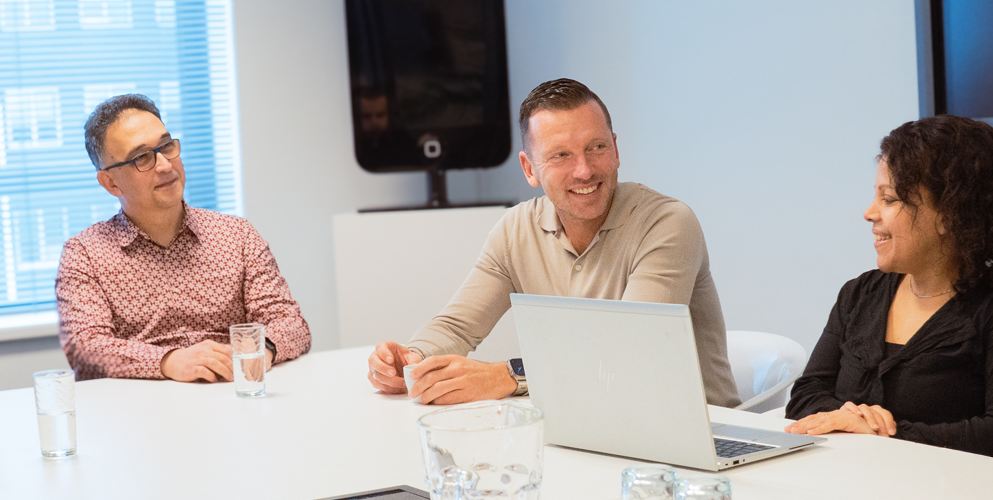

Healthcare IT is facing many specific challenges regarding data. How can we ensure that care data is available when it needs to be, when it can make a real difference to patient outcomes? How do we leverage the promise of technological advancements like AI if we cannot trust that the data it is working with is both accurate and consistent? We discussed these challenges and the difference Cadasto can make with our Founder and Architect Sebastian Iancu and our CEO Niels Greidanus. What are their hopes for Cadasto? Let’s find out!
What challenges do you see in healthcare IT?
Niels: “It seems to me that while awareness concerning the necessity of data availability in healthcare has grown in recent years, we still have quite a long way to go to actually make it happen. Vendor lock-in is still very much an issue – big vendors dominate the market. This is what stifles innovation and freedom in the market. It is only in recent years that the discussion has shifted from facilitating data exchange to creating true data availability – and that these are two wholly different things. These discussions were necessary to bring us to where we are now – and now is the time to really get our collective hands dirty and change the fabric of healthcare IT for the years to come.”
Sebastian: “Exactly, even after all of these years discussing data availability, it is still not a given. Even so, technological advances are ongoing – think of, for example, how AI tooling is making it easier to both leverage information and build new applications. This also means that having quality data has become even more important. LLMs are able to use unstructured data, but it comes with the risk of having less relevant or even less factual output, which can pose a real risk in healthcare. Structured data means consistency and accuracy.”
“I used to wonder whether the rise of AI meant that a standard like openEHR would lose its function – now I see that it has become more relevant than ever. It allows us to feed AI with relevant and consistent data – to actually being able to use AI in healthcare settings, this is a must.”
How do you think Cadasto will be able to make a difference?
Niels: “Open data platforms such as Cadasto have an important role to play when it comes to true data availability and facilitating a consistent foundation for care data. We want to make it both accessible and affordable to make the shift to using such a platform – for both healthcare organisations and software vendors.”
Sebastian: “Yes – one of the ways in which we make Cadasto more accessible is by adhering very strictly to the openEHR standard rather than to specific demands from individual organisations. This is where our approach differs from that of other vendors, I believe – when deciding on the structure of Cadasto, we chose as generic an approach as possible, so that it was possible for us to, for example, use the openEHR Demographics Specifications. When you stick to the openEHR Specifications as closely as possible, you have the highest degree of standardisation and the least complexity.”
How will Cadasto co-exist with other similar open data platforms?
Sebastian: “Of course there will be organisations and software suppliers for whom one open data platform will suffice, but we believe that for larger organisations and regional or even national healthcare collectives, it will be most beneficial to use multiple (federated) platforms. Think of, for example, using one platform as a Vendor Neutral Archive for historical data and leveraging an aggregation of this data with newer data from another platform or EHR to create a more complete picture.
Also, I think the market will only benefit from simply having more options, more competition if you will. Choice has been relatively limited so far and there were multiple gaps to fill.”
Niels: “Cadasto offers some specific things that other vendors do not (like openEHR Demographics and SMART on openEHR) and vice versa. We believe Cadasto has its part to play and we aim to do so in collaboration with others, to truly help healthcare forward.”
What are your hopes for Cadasto, going forward?
Sebastian: “To offer the best openEHR data platform on the market, of course! But also, we just want to demonstrate that standardisation works and that implementing an open platform should and can be an accessible and worthwhile endeavour. Also, as a developer myself, I hope and expect that Cadasto will help many developers to use openEHR as a data foundation for their applications. This will drive even more innovation, which will benefit the entire industry.”
“While talking about data standards and data reusability sounds abstract to many, not having data-availability has very real consequences for all of our day to day lives. I am personally very excited about being able to facilitate real change here, on both a smaller and larger (regional, national or even international) scale, with Cadasto.
It’s not about a checkmark next to a compliancy box, it is about truly helping both the healthcare provider and the patient, about fostering innovation by supporting developers.”
Niels: “We are currently partnering with multiple new Value Added Resellers in order to grow the use of our platform more quickly and we are excited to connect with more international VARs as well. Do drop us a message if you are keen to change healthcare IT with us!”
Join our free webinar
Would you like to find out more about Cadasto and what it has to offer your organisation?
On Tuesday 10 February at 11:30, Sebastian Iancu and Gertjan Bult will be hosting a live webinar to tell you all about it and answer any questions you may have. Subscribing is free – see you then!